Time-to-Target Scaling on D-Wave's Pegasus Instances: Exponent 0.44 vs 1.69 for Quantum Annealing with Error Correction
One GPU parallel-tempering solver on three standard spin-glass families, 250,057 recorded runs on 8×H100, with NVIDIA cuOpt as the exact baseline and ground-state certifier. A lower scaling exponent means time to target grows more slowly with problem size.
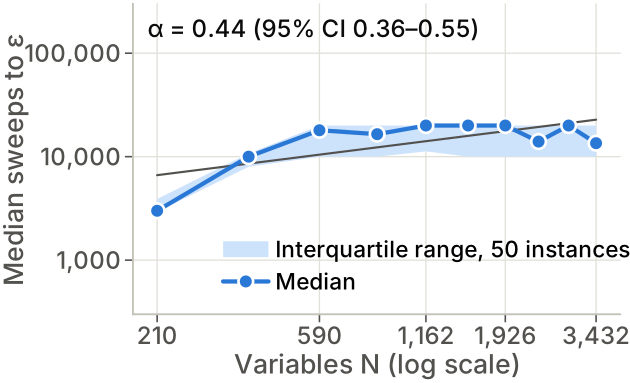
α = 0.44Pegasus time-to-target exponent at ε = 1%, in sweeps (95% CI 0.36–0.55); published: quantum annealing correction 1.69, PT-ICM 1.93
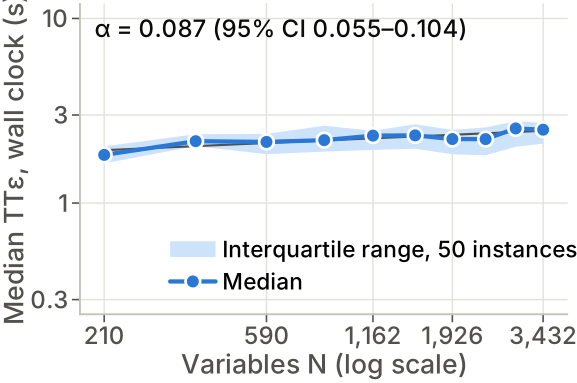
α = 0.087wall clock (95% CI 0.055–0.104), mostly fixed start-up
4 / 4cuOpt-proven 3D Edwards–Anderson ground states reached (max relative gap 6×10⁻⁸)
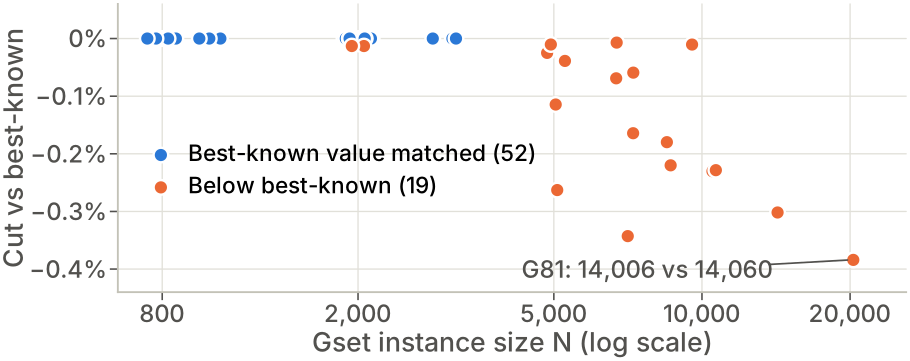
52 / 71Gset best-known values matched; mean 99.962% of best-known
| Method, ε = 1% | Scaling exponent α | Sizes N | Ground-state reference | Time counted |
|---|---|---|---|---|
| This work, sweeps | 0.44 (0.36–0.55) | 210–3,432 | lowest found (E₀) | sweeps × restarts |
| This work, wall clock | 0.087 (0.055–0.104) | 210–3,432 | lowest found (E₀) | full run on one H100 |
| QAC, D-Wave Advantage | 1.69 ± 0.12 | 142–1,322 | Gurobi-certified | anneal time |
| PT-ICM, CPU | 1.93 ± 0.03 | 142–1,322 | Gurobi-certified | runtime to target |
- Pegasus, ε = 1%: sweeps grow as N^0.44 over 16× in N; wall-clock time to target stays 1.8–2.5 s on one H100, with all 500 instances reaching the target
- 3D Edwards–Anderson: target reached on 492 of 500 instances; simulated annealing is faster on the smallest ±J lattices
- cuOpt proves ground states only at L = 6 in 300 s; the GPU solver reaches all 4
- Gset: 52 of 71 best-known values matched; the other 19 within 0.39%